
PSA Exhaust CO₂ Recovery Device
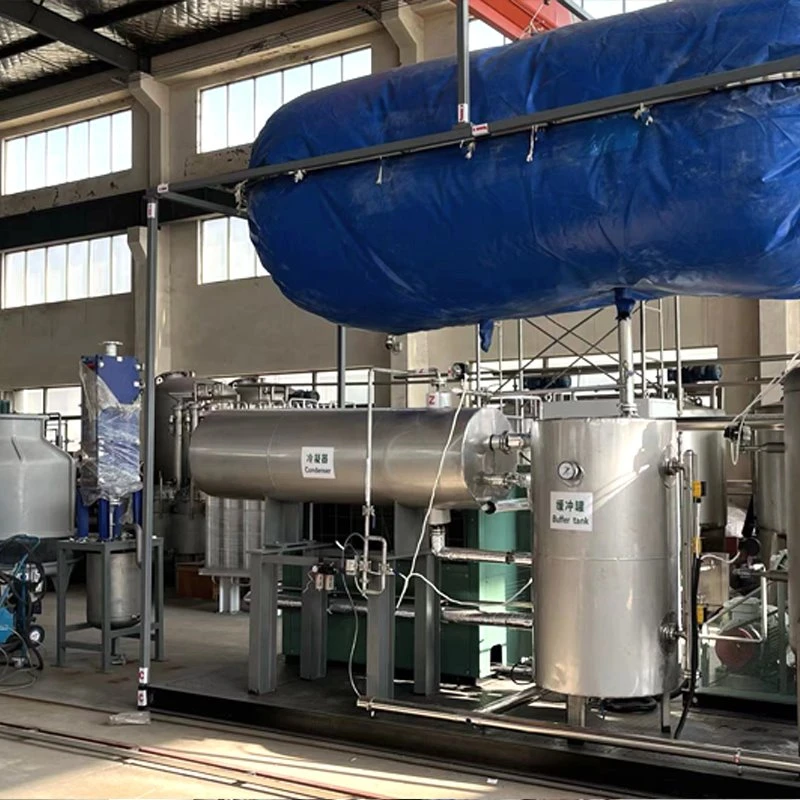
The skid-mounted system can include feed gas pretreatment, separation vessels, vacuum machinery, automated cycle controls, and battery-limit interface points for downstream process integration, compression, or liquefaction.
Overview
The PSA Exhaust CO₂ Recovery Device is an engineered gas separation system designed to recover and upgrade carbon dioxide from Pressure Swing Adsorption (PSA) tail gas streams.
The skid-mounted system can include feed gas pretreatment, separation vessels, vacuum machinery, automated cycle controls, and battery-limit interface points for downstream process integration, compression, or liquefaction.
CO₂ Recovery Performance
|
Parameter |
Baseline PSA/VPSA Scope |
Optional Downstream Scope |
Engineering Notes |
|
Product CO₂ Capacity |
500–10,000 Nm³/h feed gas (1–20 t/h CO₂) |
Multi-skid modular expansion |
At 0°C, 101.325 kPa |
|
Product CO₂ Purity |
95.0–99.0 vol% (dry basis) |
Up to 99.9 vol% |
Subject to impurity limits |
|
CO₂ Recovery Rate |
80–90% |
90–95% with recycle |
Depends on feed conditions |
|
Outlet Pressure |
0.02–0.15 MPa(g) |
2.0–2.5 MPa(g) with booster |
Confirm downstream requirements |
|
Product Dew Point |
Moisture-saturated gas |
−40°C to −60°C with dryer |
Specify guaranteed value |
|
Specific Power Consumption |
0.12–0.25 kWh/Nm³ CO₂ |
Includes booster and dryer |
Excludes liquefaction |
Typical Upstream Feed Gas Sources
Hydrogen PSA Tail Gas (SMR / Reforming): CO₂ concentration: 45–70 vol%; balance components may include H₂, CH₄, CO, and H₂O.
Ammonia & Methanol Syngas Purge Gas: CO₂ concentration: 30–60 vol%; balance components may include N₂, H₂, CH₄, and CO.
Coal-to-Chemicals / Shift Gas Desorption Stream: CO₂ concentration: 50–85 vol%; other components may include CO, H₂, and trace amounts of H₂S and COS.
Feed Gas Operating Limits & Impurity Tolerances
Feed CO₂ Concentration: 30–70 vol% (typical operating range).
Inlet Feed Pressure: 0.01–0.5 MPa(g) (10–500 kPa(g)) at the skid battery limit.
Inlet Feed Temperature: 15–40°C. Temperatures above 45°C may require an upstream gas cooler, depending on the process design.
Hydrogen Sulfide (H₂S) & Total Sulfur: ≤ 10 ppmv. H₂S concentrations above 10 ppmv may require upstream desulfurization to protect the adsorbent, subject to the selected adsorbent's sulfur tolerance.
Moisture & Free Liquids: Free water droplets must be removed using an inlet knockout drum. The allowable moisture content of the gas after separation must be specified in the design basis.
Oil Aerosol Content: ≤ 0.01 mg/m³. Coalescing filtration may be required if the feed gas comes from lubricated blowers or compressors.
PSA Adsorption & Regeneration Process
Feed Pretreatment: Free liquids and particulates are intercepted to prevent contamination of active adsorbents and process control valves.
Selective Adsorption: Feed gas passes through active adsorption vessels where CO₂ is preferentially adsorbed by target-selected media.
Desorption & Regeneration: Adsorbed CO₂ is released through a controlled reduction in bed pressure. Depending on the selected cycle, regeneration may use pressure blowdown, vacuum-assisted desorption, or a combination of these steps.
Equalization & Switching: Multi-bed vessel sequencing with pressure equalization steps balances vessel pressures, conserves utility power, and maintains steady downstream gas flow.
Product Buffering: Regenerated CO₂ flows to a surge vessel to buffer cyclic switching variations before reaching the skid battery limit.
Quality Assurance
Welding Qualifications: Welding procedures and personnel are qualified to ASME Section IX or equivalent national standards.
Non-Destructive Testing: RT, UT, or PT inspections are performed according to design codes, pressure ratings, and contract requirements.
Pressure Testing: Pressure vessels undergo hydrostatic testing, while assembled piping headers receive pneumatic tightness testing.
Quality Documentation: The project quality dossier includes EN 10204 3.1 material certificates, NDT records, pressure-test reports, and factory inspection documents.
Compliance: Manufacturing follows an ISO 9001-certified quality system, with applicable pressure-vessel codes and regional standards supported when required.
Installation & Integration
Battery Limits: Flanged connections are provided for feed gas, CO₂ product, purge gas, and condensate drainage in accordance with applicable ASME, EN, or DIN standards.
Foundations: A level concrete pad must support the skid's static weight and the dynamic loads generated by vacuum equipment or compressors.
Installation Conditions: Systems are suitable for indoor or outdoor installation within the specified ambient range. Cold-weather insulation and heat tracing are available.
Scope of Supply: The supplier provides skid-mounted equipment, internal piping, and controls. The buyer provides civil works, external piping, main power cables, and utilities.
Engineering Documents: GA drawings, foundation load data, and interface schedules are supplied for review.
FAQ
Q: Should I choose PSA/VPSA or amine absorption?
A: PSA/VPSA is generally more economical for low-pressure feed gas containing more than 30% CO₂. Amine absorption is better suited to dilute streams below 20% CO₂, such as boiler flue gas.
Q: What purity can be expected from a 99% product?
A: Typical limits include H₂ below 0.1%, CH₄ below 0.5%, CO below 100 ppm, and N₂ below 0.5%. Final guarantees depend on the feed-gas composition.
Q: How much CO₂ can be recovered?
A: A 5,000 Nm³/h feed stream containing 55% CO₂ can produce approximately 4.9 t/h, or 117 t/day, at a 90% recovery rate.
Q: What is the total energy consumption?
A: The complete process typically consumes 0.30–0.52 kWh/Nm³ of CO₂, including VPSA separation, compression to 2.0 MPa, and liquefaction. This equals approximately 150–265 kWh per ton of liquid CO₂.
Q: Can sulfur-containing gas be treated?
A: Yes, but H₂S and COS must generally be reduced to below 10 ppmv upstream, using zinc oxide or activated carbon, to prevent permanent adsorbent damage.
Q: How long do the adsorbent and main components last?
A: CO₂-selective adsorbent typically lasts 5–8 years, switching valves 3–5 years, and vacuum pumps require overhaul every 16,000–24,000 operating hours.
Hot Tags: psa exhaust co₂ recovery device, China psa exhaust co₂ recovery device manufacturers, suppliers, factory, byproduct gas recovery equipment, byproduct gas resource recovery, carbon dioxide recovery from biogas, gas recovery compressor system, gas recovery unit process control, industrial gas capture system
You Might Also Like


Send Inquiry