

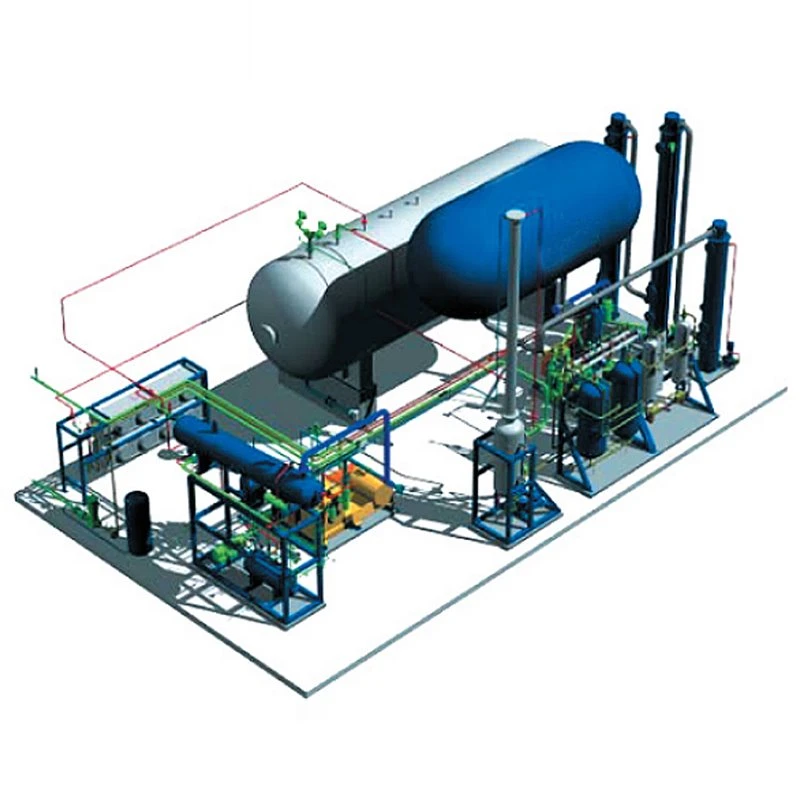
CO₂ Recovery Unit for Brewery Fermentation Gas
The modular package integrates raw gas collection headers, multi-stage water washing, oil-free gas compression, activated carbon organic filtration, twin-tower desiccant drying, non-condensable stripping, sub-cooling liquefaction, and central process controls.
Introduction
An industrial gas recovery unit designed to collect, purify, and liquefy raw fermentation off-gas from brewery cellars.
The modular package integrates raw gas collection headers, multi-stage water washing, oil-free gas compression, activated carbon organic filtration, twin-tower desiccant drying, non-condensable stripping, sub-cooling liquefaction, and central process controls.
Technical Specifications
|
Parameter |
Specification |
|
CO₂ Recovery Rate |
90.0%–92.1% |
|
Recovery Losses |
Venting, regeneration blowdown, non-condensable gases |
|
Specific Energy Consumption |
110–140 kWh/t CO₂ |
|
Cooling Water Temperature |
25°C |
|
Instrument Air Pressure |
6–7 bar(g) |
|
Media Service Life |
8,000–12,000 operating hours |
|
Control System |
Siemens S7-1500 / Allen-Bradley PLC |
|
Safety Interlocks |
Pressure, lubrication, and temperature fault shutdown |
|
Purity Protection |
Automatic off-spec gas diversion |
|
Overpressure Protection |
Safety relief valves and rupture discs |
|
CO₂ Safety Integration |
Ambient CO₂ monitoring and emergency ventilation |
CO₂ Recovery Capacity
Nominal Recovery Capacity: Available in standard skid sizes from 50 kg/h to 1,500 kg/h (approx. 1.2 to 36 t/day) of purified liquid CO₂ product.
Inlet Gas Operating Range: Designed for raw fermentation off-gas entering at 95% to 99% v/v CO₂ concentration (dry basis) under low-pressure cellar collection conditions (10–50 mbar gauge).
Low-Concentration Venting Logic: If raw gas concentration drops below 95% v/v during initial cellar blow-off, an automated sensor-driven 3-way divert valve routes the stream to an external safe exhaust stack.
Brewery Scale Alignment: Sized for regional craft breweries through multi-million HL industrial facilities processing annual production volumes from 100,000 HL to over 3,000,000 HL.
CO₂ Quality
Final Product Purity Target: Engineered to achieve a target CO₂ purity of 99.99% v/v on a dry basis under rated operating parameters.
Key Impurity Thresholds: Oxygen (O₂) ≤ 5–10 ppm v/v; Moisture (H₂O) ≤ 10 ppm v/v (dew point below -60°C); total volatile organic hydrocarbons ≤ 5 ppm v/v.
Guideline Alignment: Equipment process engineering follows the quality and safety principles outlined in ISBT and EIGA beverage-grade CO₂ guidelines.
Analytical Verification: Process verification utilizes continuous online trace-oxygen and dew-point monitoring, with certified third-party laboratory batch analysis reports available upon request.
Impurity Removal
Foam Separation and Water Scrubbing: Stainless steel foam separator followed by a packed water wash tower removes entrained foam, water-soluble esters, and residual ethanol vapors.
Organic Hydrocarbon Absorption: Dual active carbon vessels strip trace volatile organic compounds (VOCs), aldehydes, and organic aroma compounds.
Gas Dehydration: Twin-tower molecular sieve desiccants adsorb moisture from the gas stream to prevent ice formation in downstream sub-cooling heat exchangers.
Non-Condensable Stripping: A distillation column separates remaining entrained oxygen, nitrogen, and argon from the liquefied product stream.
Liquid CO₂ Storage Capacity
Storage Vessel Options: Vacuum-insulated steel pressure tanks from 5 m³ to 50 m³ (design pressure 22 bar gauge) are available as selectable system options.
Transfer Interfaces: Main skid discharge piping terminates in standard flanged manifolds suitable for connection to optional storage tanks, existing site storage, or external tank truck loading lines.
Downstream Supply Components: Optional ambient or steam-heated vaporizers convert stored liquid back to gaseous CO₂ for counter-pressure filling, tank blanketing, and bottle purging.
Installation Requirements
Cellar Tie-in: Direct flanged connection to the central cellar collection header, featuring sanitary stainless steel check valves and inline foam detection sensors.
Footprint Requirements: Equipment requires installation within a covered or indoor facility.
Utility Terminal Points: Standard flanged connections for cooling water supply/return, instrument air, main power distribution, and product delivery lines.
Electrical Supply Options: Configured at the factory for 380V, 415V, or 460V, 3-Phase, 50/60 Hz to match regional project site power standards.
Equipment Compliance
Pressure Vessels: Designed and manufactured to ASME Section VIII, Division 1 or GB 150, according to regional requirements.
Materials: SS304/SS316L is used for wetted parts and product piping, while coated carbon steel is used for structural frames.
Welding and NDT: Certified welders perform SAW and TIG welding. Pressure-retaining seams undergo applicable NDT, including RT and UT.
Factory Testing: All pressure vessels, piping assemblies, and valve manifolds undergo hydrostatic and pneumatic leak testing before shipment.
Quality Management: Manufacturing is conducted under an ISO 9001-certified quality management system.
FAQ
Q: Should I recover CO₂ or continue buying liquid CO₂?
A: Recovery is generally suitable for breweries producing more than 300,000 HL annually with steady CO₂ demand. Smaller breweries or those with seasonal demand may find purchased CO₂ more economical.
Q: What is the estimated equipment cost?
A: A 300 kg/h unit typically costs USD 0.35–0.6 million, while a 1,500 kg/h unit costs approximately USD 1.2–2.0 million, excluding storage tanks, civil works, and import duties.
Q: How much CO₂ can a brewery recover?
A: A brewery generates approximately 2.5–3.5 kg of CO₂ per hectoliter of beer.
Q: Why must fermentation gas contain more than 95% CO₂?
A: Early fermentation gas contains air, which increases oxygen and nitrogen levels.
Q: What does the energy consumption include?
A: Typical energy use is 110–140 kWh/t, covering gas compression, drying, liquefaction, and auxiliary systems.
Q: How long do the adsorbents last?
A: Activated carbon typically lasts 8,000–12,000 hours, or approximately 1–1.5 years. Molecular sieve media generally lasts 3–5 years.
Q: How is beverage-grade purity verified?
A: Online analyzers continuously monitor oxygen and dew point. Laboratory testing verifies benzene, acetaldehyde, ethanol, total hydrocarbons, and sulfur compounds against applicable ISBT requirements.
Hot Tags: co₂ recovery unit for brewery fermentation gas, China co₂ recovery unit for brewery fermentation gas manufacturers, suppliers, factory, carbon dioxide recovery from biogas, CO2 recovery unit condenser, converter gas recovery system, industrial gas capture system, industrial gas recovery technology, industrial waste gas recovery system
You Might Also Like


Send Inquiry